
Commentary, Bob McCarthy
An attendee of VitaCyte’s last human islet isolation webinar asked the above question during the Q&A session after Bala’s last webinar, where he reviewed his method to improve islet recovery from young donors. A webinar using the same title as this blog post will be held at 11 am EDT on Thursday, June 18, 2026. To answer this question, I have assembled a panel of experts who were responsible for the decision to change the enzyme dose or, after adopting the new dose, performed numerous isolations to validate its performance.
This article summarizes the conclusions from two pivotal studies that influenced the determination of collagenase-protease dose used for human islet isolation.
How was the Enzyme Dose Set Initially?
Setting the dose of a purified mixture of collagenase-protease enzymes began with a reference point. The reference point was the dose of Boehringer Mannheim Biochemicals’ (BMB) Collagenase P that Camillo Ricordi’s lab used for human islet isolation. Collagenase P was launched in 1990 and was unique when compared with those similar products offered by Sigma or Serva in several key respects.
- Each “fermentation campaign” contained 4 or 5 different lots of product
- Ricordi found that about 30% of these lots were effective for providing enough islets for transplantation
- Ricordi’s search for new “good lots” of Collagenase P was continuous, since the product’s shelf life was ≈ 1 year for this application.
In 1991, BMB (Indianapolis) was concerned that a “research use only” product was being used at the University of Pittsburgh to prepare cells for clinical studies. After two BMB staff members visited Pittsburgh to obtain more information about this product application, Ricordi was invited to Indianapolis to discuss the importance of collagenase in human islet isolation. His visit convinced senior management to fund a ten-person project team to identify and manufacture the enzymes required for human islet recovery found in “good lots” of Collagenase P. The co-founders of VitaCyte played key roles in this project. Francis Dwulet identified the active enzymes, developed collagenase purification methods, and worked with BMB Operations to scale up product manufacturing. I was the project leader, responsible for managing project activities. The details of Liberase HI’s development are summarized in an earlier blog post by Dwulet and will not be reviewed here.
Fetterhoff et al. summarized the results from 26 human islet digestions performed at BMB.(1) The focus was on digestion, not islet isolation. This distinction is made because the BMB project team used an automated image analysis system to count islets throughout the 45-minute digestion period. Here, the tissue is used as an enzyme substrate, where different collagenase-protease enzyme mixtures produce a free islet product from the pancreas.(2) This approach simplified the research by avoiding the issues of islet purification, which, at that time, were unsettled in the field.
The above report used the modified Ricordi method for islet isolation performed at that time. The key modifications/results are summarized below.
- No effect on islet yields when perfusing the pancreas with 0.75, 1.5, or 3 mg/mL of warm Liberase in an HBSS-DNAse solution (0.2 mg/mL DNAse I)
- No adjustments to the enzyme dose were made for organ mass
- The Liberase concentration in the Ricordi digestion circuit was 1.5 mg/mL in HBSS-DNAse, regardless of the Liberase concentration used to perfuse the organ
- The first version of Liberase HI contained ≈ 12,000 BAEE U of clostripain per bottle, a contaminant later removed in the second version of Liberase(3)
- One bottle of Liberase containing 1600 Wunsch Units (WU) was used per organ
A notable observation in the Fetterhoff et al. report is that older donors (>25 years old) produced significantly higher total islet equivalent (IEQ) counts (1.9x) than younger donors (<25 years old). However, there was no difference in digestion IEQ counts when expressed as IEQ per g of tissue. This observation is consistent with feedback from experts who told me that the best Liberase product was version 1, which contained a substantial amount of clostripain. Thirty-one years later, it again emphasizes the importance of using multiple proteases for human islet isolation.(3)
The Liberase™ Purified Enzyme Blend was launched in the US in November 1994 and shortly thereafter, Linetsky et al. (4)and Olack et al. (5) confirmed the effectiveness of Liberase HI in isolating human islets compared with their current crude collagenase products. This product soon became the gold standard for isolating islets used for islet transplantation.
Further studies at the University of Minnesota changed the enzyme dose per organ to per g of trimmed tissue. Adjusting the enzyme dose to tissue mass improved dose control. An earlier report from Edmonton showed that when Liberase was delivered to the pancreas, Wunsch activity per g tissue ranged from 10.8 to 81.6 WU/g tissue. They also found that islet yields did not correlate with Wunsch activity. (6)
Limitations of Using Liberase HI Set an Optimal Enzyme Dose for Human Islet Isolation
The reference point for the development of the Liberase HI product was the enzyme compositions and activities similar to those of “good lots” of Collagenase P used for human islet isolation. Results from this “reverse engineering” project enabled publication of the Edmonton Protocol, but from a clinical cell manufacturing perspective, the limits of the enzyme composition and dose were unknown.
In 2010, VitaCyte received a Phase II Small Business Innovation Research Award from NIDDK that included funding to assess the performance of recombinant class I (rC1) and class II (rC2) in human islet isolation. This funding enabled VitaCyte’s scientists to use a design-of-experiments approach to determine the effects of four different rC1 and rC2 enzyme mixtures on human islet yields. An overview of these results and the key findings are summarized below.
Prospective Study to Determine the Optimal Enzyme Dose for Human Islet Isolation
For all isolations, the dose of neutral protease was fixed, using BP Protease (a Dispase equivalent enzyme) at the same neutral protease activity as found in NB Protease (1.75 DMC U/g tissue) used in the new enzyme mixture (NEM).(7) One of the four collagenase enzyme mixtures was used in each isolation, with the islet isolators “blinded” to the collagenase enzyme compositions used in this study.
These key results are summarized below. (8)
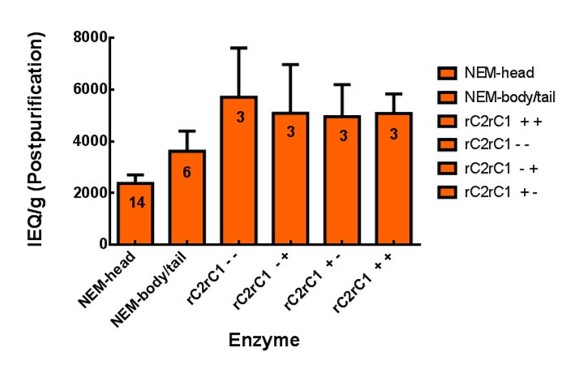
- The four collagenase enzyme mixtures gave equivalent results, as shown in the Figure below.
- -/-: 100,000 collagen degradation activity (CDA)rC1/ 12 Wunsch U (WU) rC2 per g tissue
- -/+: 100,000 CDA U rC1/ 20 WU rC2 per g tissue
- +/-: 200,000 CDA U rC1/ 12 WU rC2 per g tissue
- +/+: 200,000 CDA U rC1/ 20 WU rC2 per g tissue
- The results from the four recombinant collagenase mixtures gave islet yields close to those found in 52% of the successful islet isolations reported in the Clinical Islet Transplantation Consortium clinical trial (9)
- The purified islet yields were significantly higher than those obtained with NEM, with the same site performing the islet isolations
These results are consistent with the mechanism of action for collagenase-mediated tissue dissociation that McCarthy et al proposed in earlier review articles (3, 10). This mechanism is shown in a recent medical animation on VitaCyte’s website.
The results from the DOE study led to further studies by Balamurugan Appalakai’s lab to validate the -/- (100,000 CDA U rC1/ 12 WU rC2) recombinant collagenase dose used for human islet isolation.(11) In 2015, VitaCyte launched the rCollagenase HI product that contained 15 million CDA U of rC1 and 1600 WU of rC2, enough enzyme to digest a 100 g pancreas. This dose is at the midpoint of the collagenase doses used in the DOE study above: 150,000 CDA U rC1 and 16 WU rC2 per g tissue. O’Gorman has validated the effectiveness of this dose in human islet isolations performed at the University of Alberta in Edmonton.(12)
The results from the studies performed by Appalakai et al. and O’Gorman et al. will be reviewed in the upcoming webinar by these two individuals. To register for the webinar or to review a recording of this webinar, visit the webinar webpage site.
In conclusion, what is the answer to the question asked in the title of this article? The short answer is that it remains a work in progress.
References
- Fetterhoff TJ, Cavanagh TJ, Wile KJ, Wright MJ, Dwulet FE, Gill J, et al. Human pancreatic dissociation using a purified enzyme blend. Transplant Proc. 1995;27:3282–3.
- Wile KJ, Schwartzkopf W, Olsen M, Laxer C, Fetterhoff T, Cavanagh T, et al. Differentiation of free and embedded porcine pancreatic islets using a novel automated image analysis algorithm. Transplant Proc. 1997;29:1974.
- McCarthy RC, Green ML, Dwulet FE. Evolution of enzyme requirements for human islet isolation. OBM Transplantation. 2018; 2:[1–30 pp.]. Available from: http://www.lidsen.com/journals/transplantation/transplantation-02-04-024.
- Linetsky E, Bottino R, Lehmann R, Alejandro R, Inverardi L, Ricordi C. Improved human islet isolation using a new enzyme blend, liberase. Diabetes. 1997;46:1120–3.
- Olack BJ, Swanson CJ, Howard TK, Mohanakumar T. Improved method for the isolation and purification of human islets of langerhans using Liberase enzyme blend. Hum Immunol. 1999;60:1303–9.
- Kin T, Zhai X, Murdoch TB, Salam A, Shapiro AM, Lakey JR. Enhancing the success of human islet isolation through optimization and characterization of pancreas dissociation enzyme. Am J Transplant. 2007;7:1233–41.
- Balamurugan AN, Loganathan G, Bellin MD, Wilhelm JJ, Harmon J, Anazawa T, et al. A new enzyme mixture to increase the yield and transplant rate of autologous and allogeneic human islet products. Transplant. 2012;93:693–702.
- Balamurugan AN, Green ML, Breite AG, Loganathan G, Wilhelm JJ, Tweed B, et al. Identifying Effective Enzyme Activity Targets for Recombinant Class I and Class II Collagenase for Successful Human Islet Isolation. Transplant Direct. 2016;2:e54.
- Ricordi C, Goldstein JS, Balamurugan AN, Szot GL, Kin T, Liu C, et al. National Institutes of Health-Sponsored Clinical Islet Transplantation Consortium Phase 3 Trial: Manufacture of a Complex Cellular Product at Eight Processing Facilities. Diabetes. 2016;65:3418–28.
- McCarthy RC BA, Green ML, Dwulet FE. Tissue dissociation enzymes for isolating human islets for transplantation: Factors to consider in setting enzyme acceptance criteria. Transplant. 2011;91:137–45.
- Loganathan G, Subhashree V, Breite AG, Tucker WW, Narayanan S, Dhanasekaran M, et al. Beneficial effect of recombinant rC1rC2 collagenases on human islet function: Efficacy of low-dose enzymes on pancreas digestion and yield. Am J Transplant. 2018;18:478–85.
- O’Gorman D, Kin T, Rosichuk S, Richer B, Zhai W, Moriarity J, et al., editors. Evaluation of a low dose recombinant collagenase and BP Protease for clinical islet transplantation. Transplant; 2021:105:S19-20.