
Commentary, Bob McCarthy
After cofounding VitaCyte in 2003, a company focused on improving enzymes for cell recovery from tissue, I realized I needed to deepen my understanding of enzyme-mediated cell isolation methods. I began reviewing books and other publications in this area, but soon found that all the general methods books on cell culture glossed over primary cell isolation. Continuing on this journey, I found the personal reminiscences from those who developed new methodologies provided new insights into the challenges they faced in isolating their cell of interest.(1, 2)
I applaud the open-science initiative for publications that describe in detail cell-isolation methods, enabling other scientists to adopt or modify them for their own use. However, a limitation is that protocol development is based on the author’s training and expertise in the field—their comprehensive understanding of the specific topic is unknown.
The recent publication of Williams’ book on Adipose Technologies sets a new standard as the first tissue-focused reference book to comprehensively review adipose tissue biology, the isolation and characterization of adipose cells and their derived cell populations recovered after culture, and the clinical and regulatory issues associated with these cells.
What I found fascinating was the chapter on “Development of Adipose Cell Isolation Methods.” Here, Williams compares methods for isolating cells from human lipoaspirate. He provides a nomenclature for identifying these methods as isolating stromal vascular fraction cells (SVF), microvascular fraction cells (MVF), and the stromal cell fraction cells (ASC) using enzymatic or non-enzymatic methods, as shown below.
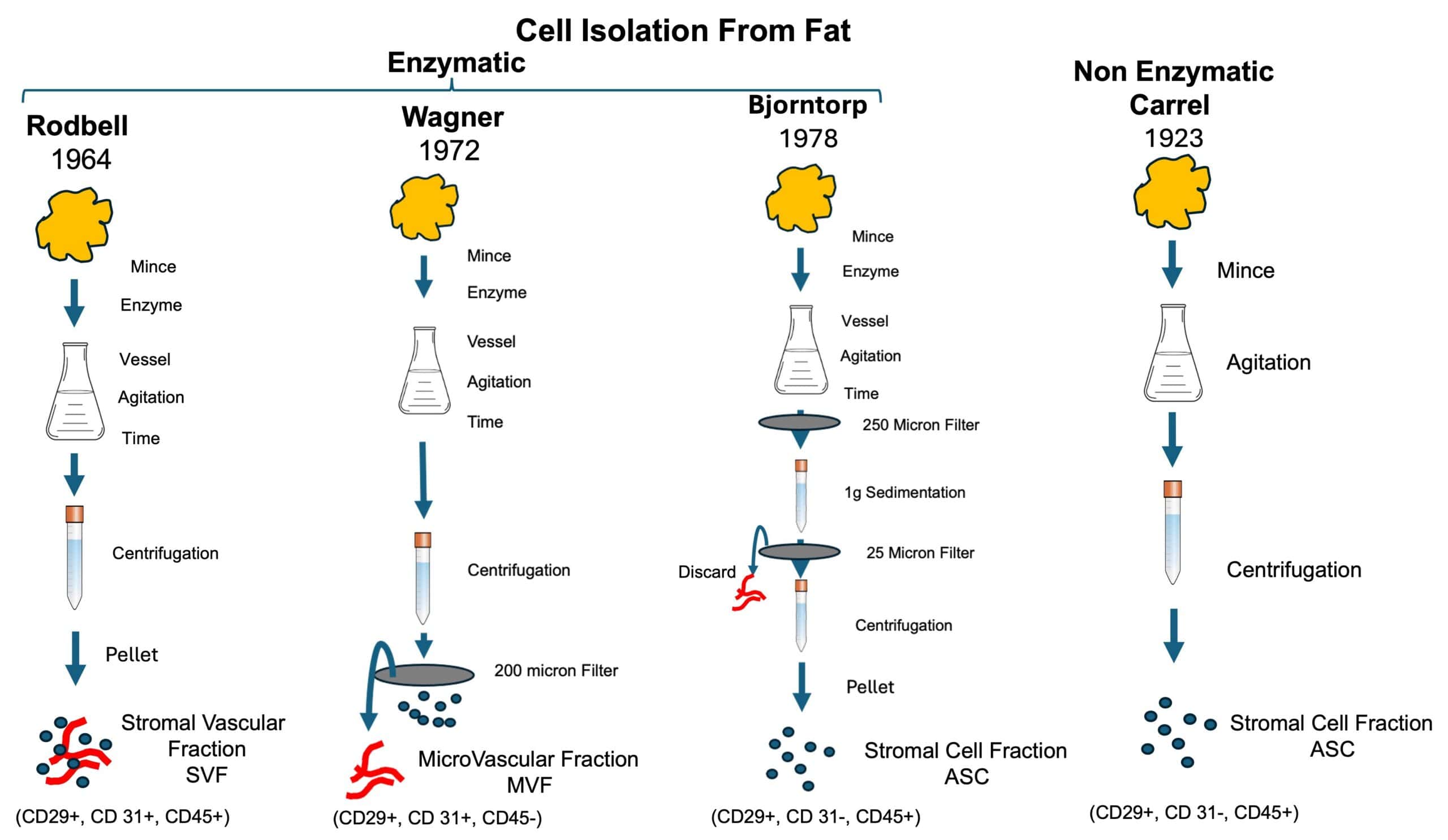
(Source: Figure 3.10, SK Williams, Adipose Technologies, 2026, reproduced with permission from SK Williams)
Adopting Williams’ terminology for adipose cell populations based on the methods used for cell isolation should minimize confusion when different laboratories compare their results.
Williams also provides an Adipose Cell Isolation Database in an Appendix that lists 163 publications that isolated cells from human lipoaspirate. For each publication, he identifies the final product standard using the nomenclature above.
I highly recommend adding this book to your reference library since it is an outstanding resource for anyone interested in the use of cells in regenerative medicine.
References
- Berry MN, Grivell AR, Grivell MB, Phillips JW. Isolated hepatocytes–past, present and future. Cell Biol Toxicol. 1997;13:223–33.
- Moskalewski S. Beginning of pancreatic islet isolation by collagenase digestion (personal reminiscences). Annals of Transplantation. 1997;2:6–7.